

The best time to overseed a lawn in Ontario is mid-August to mid-September. Here is the step-by-step method, seeding rates by grass type, a watering schedule that works, and the spring mistake that kills new seed.
When to overseed in Ontario
The best time to overseed a lawn in Ontario is late summer to early fall, roughly August 15 to September 15. The soil is still warm, nights are cooler, weeds are winding down, and seedlings get two to three months of growing weather before winter. Spring works, but it is a distant second.
That window comes from turf research, not habit. UMass Extension says late-summer renovation (August 15 to September 15) generally gives the best results, and that spring seeding runs into weed competition, summer drought and heat. Penn State Extension notes that cool-season grasses produce their best roots at soil temperatures of 10 to 18°C (50 to 65°F), the cooling soil that early fall delivers.
| When | Conditions | Verdict |
|---|---|---|
| Mid-August to mid-September | Warm soil, cooler nights, fewer weeds | Best window |
| Late September to early October | Soil cooling, growth slowing | Workable; less time to mature before winter |
| Mid-October onward | Cold soil, short days | Too late for a normal overseed |
| April | Cold, wet soil | Slow; seed can sit for weeks |
| May | Warming soil, crabgrass sprouting | Second-best; skip the corn gluten meal |
| June to early August | Heat and drought | Poor without heavy watering |
How to overseed a lawn, step by step
Fix whatever thinned the lawn, mow short, rake out thatch, core aerate, spread seed in two directions, rake it in lightly, feed with a starter fertilizer, and keep the surface damp until the seedlings are up. Mow for the first time when the new grass reaches about 8 cm (3 in).
Steps 3 and 4 are where most DIY overseeding fails. Seed thrown on top of thatch sits on a dry mat, gets eaten by birds or washes into the gutter with the first heavy rain, and the bag gets blamed.
- Fix the cause first: shade, compaction, poor drainage or grubs will thin new grass too.
- Mow lower than usual, around 4 to 5 cm (1.5 to 2 in), and bag the clippings.
- Rake out dead grass and debris. If the thatch layer is thicker than about 8 mm (1/3 in), dethatch.
- Core aerate so seed can drop into the holes and reach soil.
- Spread half the seed walking one direction and half at right angles to it. UMass aims for 15 to 25 seeds per square inch.
- Rake lightly so seed sits no deeper than about 6 mm (1/4 in), then roll or tamp for seed-to-soil contact.
- Apply a starter fertilizer.
- Water lightly two to three times a day until the seedlings are up.
- Feed again once the seedlings are about 5 cm (2 in) tall.
Overseeding after aeration: why the order matters
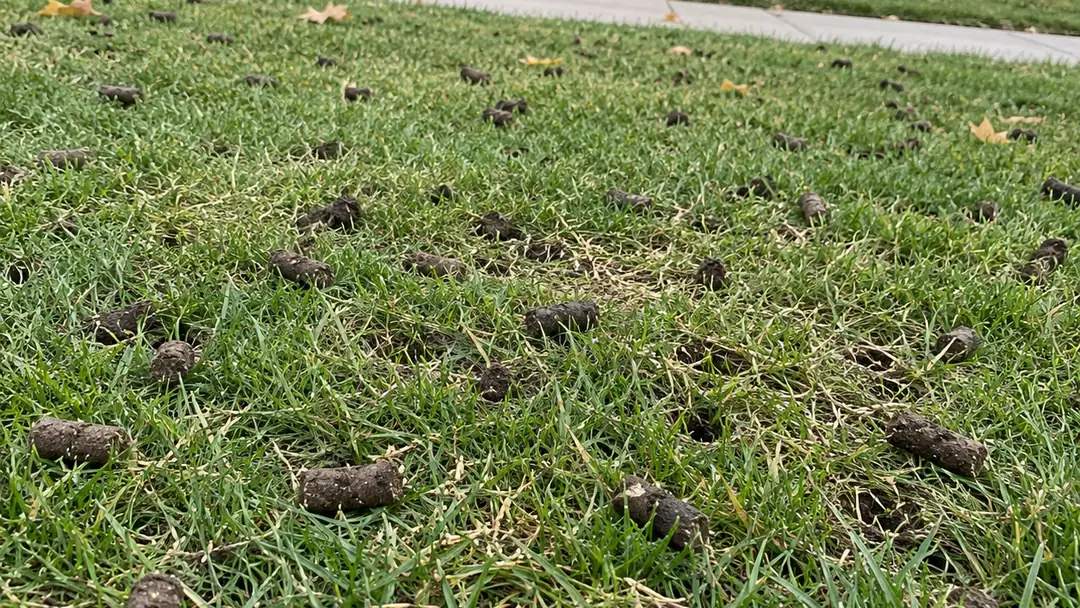
Aerate first, then overseed the same day. Core aeration pulls plugs from compacted soil and leaves thousands of small holes, and seed that drops into them gets soil contact, moisture and shelter. On the heavy clay common in Milton, Brampton and Mississauga, that step decides how much seed actually takes.
We cover the timing in when to aerate your lawn in Ontario, and our aeration and overseeding service handles both together. Leave the cores on the lawn; rain and mowing break them down within a couple of weeks, and they return soil and organic matter to the surface.
Seeding rate per 1,000 sq ft by grass type
For seeding bare soil, Ohio State University recommends 2 to 3 lb per 1,000 sq ft for Kentucky bluegrass, 7 to 8 lb for perennial ryegrass, 8 to 10 lb for tall fescue and 3 to 6 lb for fine fescues. Overseeding a lawn that still has decent cover usually takes less.
Most Ontario lawns are a mix, so follow the rate printed on the bag for that blend. UMass lists 3 to 4 lb per 1,000 sq ft for a typical sun mix of bluegrass, ryegrass and fine fescue, and 4 to 6 lb for a shade mix heavy in fine fescue. More is not better: UMass warns that seeding above the recommended rate crowds in weak, immature plants. Not sure which blend fits your yard? Our guide to the best grass seed for Ontario lawns sorts it by sun, shade and traffic.
Quick math: a 5,000 sq ft backyard overseeded with a sun mix at 3 lb per 1,000 sq ft needs 15 lb of seed. Buy certified seed and check the label for the weed seed and "other crop" percentages before you pay.
| Grass | lb per 1,000 sq ft | kg per 100 m² | Best for | Speed |
|---|---|---|---|---|
| Kentucky bluegrass | 2 to 3 | 1.0 to 1.5 | Full sun; spreads to fill gaps | Slowest |
| Perennial ryegrass | 7 to 8 | 3.4 to 3.9 | Fast cover, high traffic | Fastest |
| Tall fescue (turf type) | 8 to 10 | 3.9 to 4.9 | Sun to part shade, drought, kids and dogs | Medium |
| Fine fescues | 3 to 6 | 1.5 to 2.9 | Shade, low input | Medium |
Watering schedule for new grass seed
Keep the top layer of soil damp, not soaked, until the seedlings are up; UMass suggests light watering two to three times a day. Once the new grass has been mowed, switch to longer, less frequent watering so roots chase moisture down. Germinating seed that dries out can die.
Fall rain often does part of the job, so press a finger into the soil before you run the sprinkler. Water in the morning where you can; evening watering leaves the lawn wet overnight. On slopes, shorter runs repeated a few minutes apart keep seed from washing downhill.
| Stage | How often | How much |
|---|---|---|
| Seeding to first sprouts | 2 to 3 times a day | Light: darken the surface, no puddles |
| Sprouts to first mow | Once a day | Longer; keep the top few centimetres moist |
| After the first mow | 2 to 3 times a week | Deep: about 2.5 cm (1 in) a week, rain included |
When to mow new grass after overseeding
Mow for the first time when the new grass is about 8 cm (3 in) tall, with a sharp blade, on a dry day, and take off no more than a third of the height. Keep heavy foot traffic and full-power leaf blowers off the new grass for the first few weeks.
In fall the bigger threat is leaves. A wet mat of maple leaves can smother seedlings, so clear them gently and often, or book a fall cleanup. Once the new grass is established, regular lawn mowing at a taller summer height keeps it thick enough to shade out weeds.
Spring overseeding and the crabgrass pre-emergent problem
In spring, a weed preventer and grass seed work against each other. Corn gluten meal, the common pre-emergent allowed under Ontario's cosmetic pesticide rules, stops roots forming on germinating seeds, and it cannot tell crabgrass from the grass you just sowed. Pick one or the other for each area.
Ontario lists corn gluten meal among the allowed products for home lawns. University of Illinois Extension explains that it inhibits root formation in germinating seeds and advises against overseeding where you apply it, and one product sold in Canada tells you to wait at least 6 to 8 weeks after applying before you overseed.
Our advice for thin Ontario lawns: skip the spring pre-emergent, patch-seed in May only where you must, and plan the main overseed for late August. A thick, fall-seeded lawn does more against next summer's crabgrass than most spring products ever will.
Common overseeding mistakes
The usual mistakes are seeding on top of thatch, using too much or cheap seed, letting the seedbed dry out, mowing too early, seeding in July heat, choosing sun grass for shade, and leaving fall leaves on new grass. Avoid those and overseeding works on most Ontario lawns.
If half the lawn or more is weeds, UMass recommends a complete renovation, and sod installation is often the faster fix. For everything else, book aeration and overseeding for late August: send your address and a photo on WhatsApp to 437-433-1994 for a free quote, usually the same day. Then match the seed to your yard with our grass seed guide.
- Throwing seed on a lawn with no raking or aeration
- Doubling the seeding rate "to be safe"
- Buying cheap seed padded with filler or weed seed
- Mowing before the new grass reaches about 8 cm
- Overseeding in June or July
- Using a sun mix under mature trees
- Applying corn gluten meal in the same spring
Frequently Asked Questions
Can I overseed without aerating?
Yes, if you rake hard enough to expose soil or run a dethatcher to scratch the surface, because seed needs direct contact with soil to root. On compacted clay lawns, common across Milton, Brampton and Mississauga, core aerating first gives far better germination than raking alone.
How long does overseeded grass take to grow in?
Perennial ryegrass is the quickest to show and Kentucky bluegrass the slowest. UMass Extension puts germination and establishment at roughly three to four weeks overall, depending on the species. Expect a patchy first month, a noticeably thicker lawn by late fall, and bluegrass still filling in the following spring.
Is it better to overseed in spring or fall in Ontario?
Fall, clearly. Mid-August to mid-September gives warm soil, cooler nights and little weed competition. Spring seeding fights crabgrass, early summer heat and drought, and you cannot use corn gluten meal as a weed preventer on the same areas. Overseed in spring only for patches that cannot wait.
Should I put topsoil over grass seed?
Only a thin layer. Seed should end up no deeper than about 6 mm (1/4 in). A light topdressing of screened compost or soil, a few millimetres thick, helps hold moisture, but burying seed under a centimetre or more of topsoil stops much of it from coming up.
How much grass seed do I need to overseed?
Multiply your lawn area by the rate on the bag. For a typical sun mix at about 3 lb per 1,000 sq ft, a 5,000 sq ft lawn needs around 15 lb. Use the higher end of the bag's range for thin or patchy lawns and the lower end for a lawn that is only slightly thin.
Sources
- UMass Extension: Lawn Renovation and Overseeding
- Ohio State University BuckeyeTurf: Turfgrass establishment series, species and cultivar selection
- Penn State Extension: The cool-season turfgrasses, basic structures, growth and development
- University of Illinois Extension: Corn gluten meal, can it naturally prevent weeds and feed your lawn?
- Government of Ontario: Pesticides (home lawns and gardens)
- Botanix: Turf Builder corn gluten meal with weed prevention (product directions)
Want Us to Handle It?
Lawn By Moe is based in Milton and serves Mississauga, Oakville, Burlington, Halton Hills, Brampton and the GTA. Free quotes, usually the same day.