
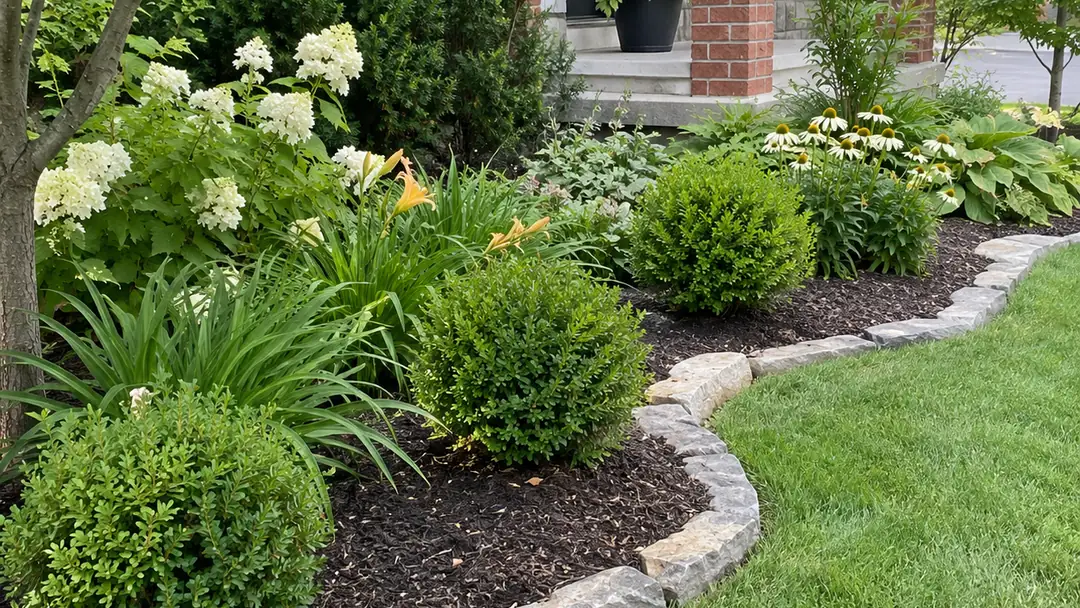
What does mulching in Milton include?
A proper mulching job in Milton is four steps: weed the beds, cut a clean edge, level or thin any old mulch, then spread 5 to 8 cm of fresh mulch kept off stems and siding. Skipping the first two steps is why a cheap mulch job looks tired by July.
Plenty of beds in newer Milton neighbourhoods like Hawthorne Village, Dempsey and Willmott look the same: thin builder mulch, a heap of it against the foundation and a lawn edge creeping into the bed. New mulch dumped on top hides that for a month. Starting from a clean edge holds the look all season.
Most homes are a one-visit job. We do the same work in Mississauga, from Meadowvale to Churchill Meadows, as our Mississauga lawn care page shows. If you want plants moved or a bed reshaped, that is our landscape design and planting work, and we quote both together.
Which mulch type is best for Ontario garden beds?
For most Milton and Mississauga beds, shredded hardwood is the best all-rounder: it knits together, stays put on slopes and breaks down into the soil. Cedar has a lighter colour and fresh smell, dyed mulch gives the strongest colour, and pine bark nuggets look neat but shift in heavy rain.
Our pick: natural shredded hardwood for backyards, and black or dark brown out front against light brick or stone. Use one type across the whole front of the house; mixing colours bed to bed looks patchy from the street.
| Mulch type | Look | Best for | Watch out for |
|---|---|---|---|
| Shredded hardwood | Natural brown, greys in sun | Most beds, slopes, tree rings | Needs a yearly top-up |
| Cedar | Light reddish brown, fresh scent | Front beds and paths | Light pieces blow around |
| Dyed black or brown | Strong, even colour | Contrast with light brick or stone | Colour fades in full sun |
| Pine bark nuggets | Chunky, rich brown | Flat, low-traffic beds | Floats in heavy rain |
How deep should mulch be, and how far from plants?
Spread mulch 5 to 8 cm (2 to 3 in) deep in garden beds and keep it off shrub stems, tree trunks and the house siding. The City of Mississauga tells residents to keep mulch around trees no deeper than 10 cm and at least 10 cm away from the trunk.
Deeper is not better. Iowa State University Extension suggests a 5 to 8 cm (2 to 3 in) layer on heavy soils, because an excessively deep layer can waterlog the soil and cut off oxygen to the roots, and mulch piled against trunks invites cankers, root rot and rodents.
Around trees we build a flat doughnut with the trunk flare showing, never the mulch volcano you see at some plazas. Along the house we leave a few centimetres between mulch and siding, so the wall can dry out and the grade still carries water away from the foundation.
How much mulch does a typical garden bed need?
One cubic yard of mulch covers about 10 square metres (108 sq ft) at 7.5 cm (3 in) deep, or about 15 square metres (162 sq ft) at 5 cm (2 in). Two front foundation beds plus a tree ring, around 15 square metres in total, take 1 to 1.5 cubic yards.
The quick maths: bed area in square metres times depth in metres gives cubic metres; multiply by 1.31 for cubic yards. One cubic yard is 13.5 bags of 2 cubic feet. A bed that still has 3 to 5 cm of decent mulch needs roughly half as much, and we measure on the quote visit.
| Area | Size | At 5 cm (2 in) | At 7.5 cm (3 in) |
|---|---|---|---|
| One tree ring, 2 m (6.5 ft) across | 3 m² (34 sq ft) | 0.2 yd³ | 0.3 yd³ |
| One front bed, 1 m x 8 m | 8 m² (86 sq ft) | 0.5 yd³ | 0.8 yd³ |
| Two front beds plus a tree ring | 15 m² (161 sq ft) | 1 yd³ | 1.5 yd³ |
| Backyard border, 1.5 m x 20 m | 30 m² (323 sq ft) | 2 yd³ | 3 yd³ |
| Full front and back beds | 50 m² (538 sq ft) | 3.3 yd³ | 4.9 yd³ |
Is spring or fall better for mulching in Milton?
Spring is the main mulching window in Milton, once beds have dried out and the soil has warmed, usually from late April into June. Fall mulching works too, after the leaves are cleaned up, and gives roots an extra blanket through winter. Avoid mulching over cold, soggy soil in early spring.
In spring we start with a cleanup so dead perennial stalks, leaves and winter debris come out first. Mulch laid over a mat of wet leaves just traps rot. Our fall lawn cleanup checklist walks through the autumn side, and a light top-up after a fall cleanup makes the beds look finished going into winter, with mulch already in place when spring weeds start.
For the full year, including how to judge depth and when to top up instead of replace, read our mulching guide for Ontario gardens.
How often should mulch be refreshed, and what does it cost?
Most beds need a top-up of 2 to 3 cm (about 1 in) once a year, with a full strip and replace every few years when the old layer mats down or builds up. We price mulching by the job after a free quote, based on bed area, depth, mulch type, access and prep work.
New customers get $25 off their first service. Send a photo of each bed on WhatsApp at 437-433-1994 and we can usually quote the same day. If the lawn beside the beds needs regular care too, our Milton lawn care page covers the area, and mulching fits easily into a season of weekly lawn mowing.
- Bed area and depth: the number of cubic yards is the biggest line on the quote
- Mulch type: prices differ between shredded hardwood, cedar, dyed and pine bark
- Prep work: heavy weeding, re-cutting an overgrown edge or removing old mulch adds time
- Access: backyards behind a narrow side gate take more wheelbarrow trips
- Haul-away: old mulch, weeds and turf cut from the edges are taken away