When is the best time to trim cedar hedges in Ontario?
Trim cedar hedges in Ontario once the spring flush of new growth is done, usually late May to June, then give them a light tidy in late summer if needed. Skip hard pruning in fall: soft regrowth from a late cut has little time to firm up before the first hard frost.
Larry Hodgson, the Quebec garden writer behind Laidback Gardener, times the main cedar trim to June, after the lilacs finish blooming, and says you can go as late as early September. That matches how we schedule hedges in Milton and Caledon: one solid trim in June and an optional end-of-summer touch-up. More detail is in our guide on when to trim cedar hedges in Ontario.
| Time of year | What we do | Why |
|---|---|---|
| April to mid-May | Remove dead and snow-broken branches | Clears winter damage before growth starts |
| Late May to June | Main shaping trim | Cuts land in fresh green growth that fills in fast |
| July to mid-August | Spot-trim stray shoots only | Nesting season is still on, so we check first |
| Late August to early September | Last light trim | Leaves time for regrowth to harden off |
| October to March | No shaping cuts | Plants are heading into dormancy |
Why shape a hedge wider at the bottom?
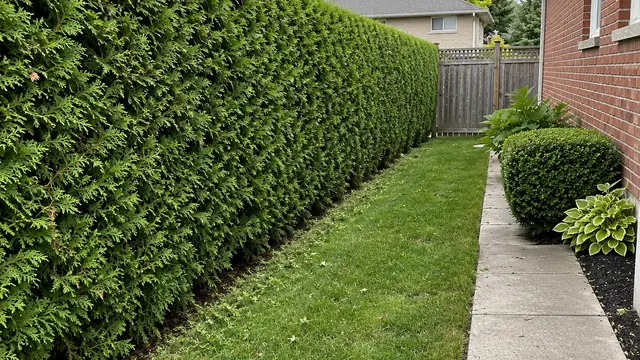
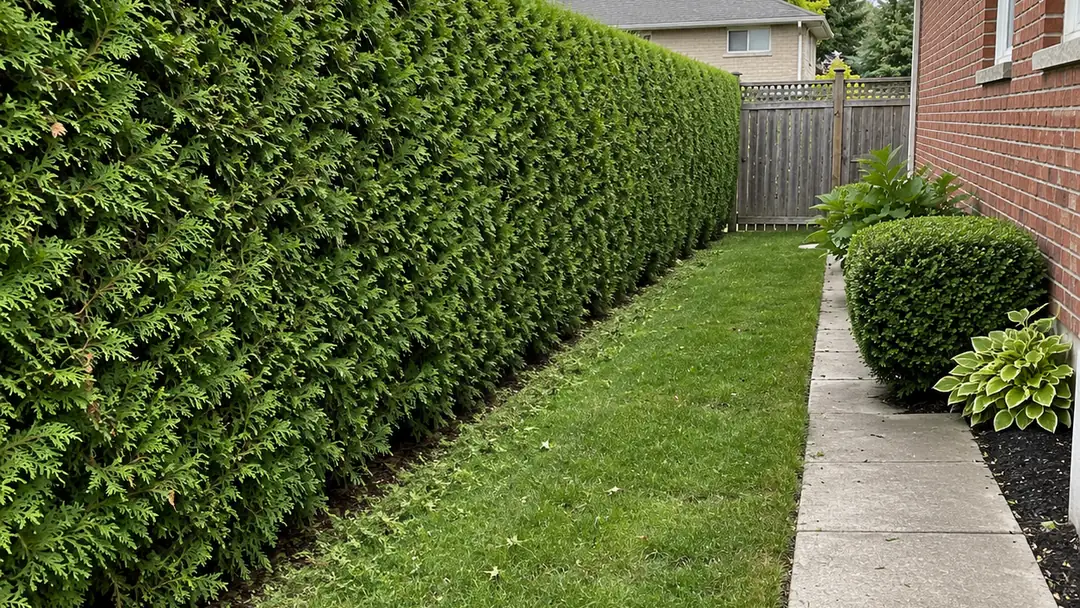
A hedge that is wider at the base than the top lets sunlight reach the lower branches, so the bottom stays green and full. Iowa State University Extension adds that the tapered shape cuts snow build-up on top, which matters in a Milton winter when wet, heavy snow can break branches.
A common complaint is a hedge that is bare at the bottom and bushy at the top. It happens when a hedge is cut straight up and down, or narrower at the base, year after year. The top shades the bottom, the lower branches thin out, and you start seeing the fence through it.
We trim with a gentle taper, a few centimetres narrower on each side at the top than at the base. From the street you barely notice it, but over two or three seasons the lower branches fill back in. Rounded or slightly peaked tops shed snow better than a flat table top.
Can you cut a cedar hedge back into the brown wood?
No. Cedars do not regrow from old brown wood that has no foliage on it. A Landscape Ontario master gardener puts it plainly: trim any evergreen, cedars included, back to old growth with no needles and it does not produce new growth. We leave green on every cut so the hedge fills back in.
That rule decides how we handle an overgrown hedge. Cutting 60 cm off in one visit would leave brown holes, so we bring the height down first and take the sides back only as far as the green allows, over two or three seasons. The same master gardener advises never removing more than half of the new growth in one trim.
Some browning deep inside a cedar hedge is normal, because the oldest inner foliage dies off as the hedge grows. Brown on the outside, at the tips, usually points to something else, such as winter burn, salt spray from the road or drought. We point out what we see on the quote visit.
Do I need to check for bird nests before trimming a hedge?
Yes. Under the federal Migratory Birds Regulations, 2022, made under the Migratory Birds Convention Act, it is prohibited to damage, destroy, disturb or remove a migratory bird nest that contains a live bird or a viable egg. Dense cedar hedges are popular nesting spots, so we check before every spring and summer trim.
Environment and Climate Change Canada publishes general nesting periods by zone. For nesting zone C, which takes in the Lower Great Lakes region, those periods start between late March and early May depending on the sub-zone and run into August. The federal guidance also notes that birds can nest before or after those dates, so the calendar is a guide, not a free pass.
Our routine is simple. Before we start, we watch the hedge for birds flying in and out, then part the foliage at points along its length. If we find an active nest, we leave a wide section around it untouched and come back to finish that part after the young have left.
What does hedge trimming cost in Milton?
Hedge trimming in Milton is priced by the job after a free quote. The price depends on the length and height of the hedge, how overgrown it is, whether the top needs ladder work, access to both sides, and the volume of clippings to haul away. New customers get $25 off their first service.
Send a photo of the full length of the hedge and one close-up on WhatsApp at 437-433-1994, and tell us the height you want to keep. That is usually enough for a same-day quote. If you want mulching and garden bed work under the hedge as well, we price both together.
- Length and height: 15 m (50 ft) of 2 m cedars is a different job from a short privet hedge
- Overgrowth: a hedge skipped for a season or two takes longer
- Access: one-sided access or a hedge tight to a fence slows the work
- Shape: flat formal tops and sharp corners take longer than a rounded trim
- Clean-up: more clippings mean more bags and loads to haul away
Can hedge trimming be combined with a fall cleanup?
Yes. Light shrub tidying, removing dead or broken branches and clearing leaves out of the hedge base all fit well into a fall cleanup in October. What we leave out in fall is a hard shaping cut on cedars, which waits for the next growing season.
Leaves that pile up at the base of a hedge sit wet against the trunks all winter, so we rake them out during a fall cleanup and cut back perennials in the beds alongside. If you have tall, multi-stem cedars, tying them loosely before winter helps stop heavy snow from splaying them open.
If a hedge is past saving, or you want the beds around it reshaped, that is our landscape design and planting work. We can plan new plants and trim what stays in the same visit.