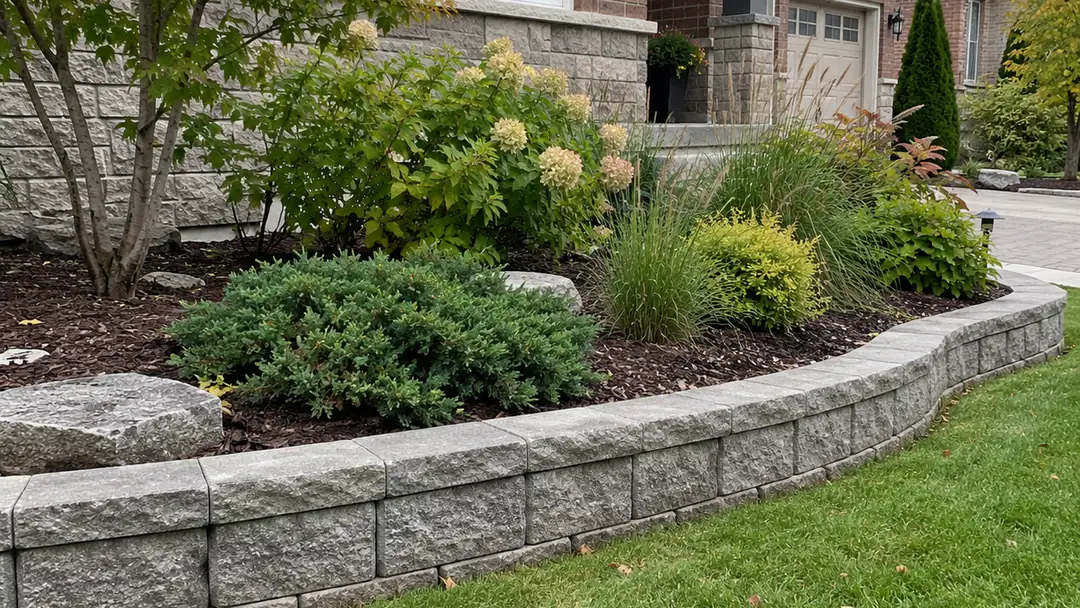
How does our landscape design and planting process work?
It starts with your photos and a site visit, where we check sun, drainage, soil and what you want the yard to do. From there you get a simple plan and plant list, a utility locate before any digging, soil prep, planting and mulch, then watering notes for the first season.
Ontario Dig Authority (formerly Ontario One Call) says a locate is free, required by law for any project that breaks ground, however small or shallow, and should be requested at least 5 business days ahead. That includes a new garden bed or tree. The marked lines also decide where a tree can go: we would rather shift a planting a metre than put roots over a gas line.
- Photos and goals: send your address and a few pictures on WhatsApp
- Site visit: sun hours, low spots, soil, and what stays or goes
- Plan, plant list and a quote you can say yes or no to
- Free utility locate through Ontario Dig Authority before digging
- Clear, loosen and amend the beds, then plant and mulch
- Watering and care notes for the first growing season
What plant hardiness zone is Milton, Ontario?
Milton is Zone 6b on Natural Resources Canada's current plant hardiness map, built on 1991 to 2020 climate data. Mississauga, Oakville and Burlington are Zone 7a, while Georgetown, Acton and Caledon are colder at Zone 6a. Older plant tags and books may still quote the previous map.
A zone is a starting point, not a promise. Exposed corner lots, windy front yards and the spot where the snow gets piled all behave colder than the map, so for evergreens and anything pricey in those spots we pick plants rated a zone hardier. It is also why a shrub that sails through winter near the lake in Oakville can struggle up in Acton.
| Town | 1961 to 1990 map | 1991 to 2020 map |
|---|---|---|
| Milton | 6a | 6b |
| Mississauga | 6a | 7a |
| Oakville | 6b | 7a |
| Burlington | 6b | 7a |
| Brampton | 5b | 6b |
| Georgetown | 5b | 6a |
| Acton | 5b | 6a |
| Caledon | 5b | 6a |
Which native plants grow well in Halton gardens?
Native plants are adapted to our climate and, as Halton Region puts it, usually need much less water once established. Good picks from its native and drought-tolerant list include black-eyed Susan, wild bergamot, New England aster, little bluestem and Penn's sedge, with ninebark, grey dogwood and serviceberry as shrubs.
We mix natives with tough garden plants rather than going all or nothing, because a front yard still has to look tidy from the street. Bergamot and asters bring in bees and butterflies through late summer, and little bluestem keeps its shape and copper colour well into winter.
- Perennials: black-eyed Susan, wild bergamot, New England aster, wild columbine, wild geranium
- Grasses and sedges: little bluestem, switch grass, Penn's sedge
- Shrubs: ninebark, grey dogwood, nannyberry
- Trees: serviceberry, red oak, white pine
How do you prepare clay soil for planting?
Clay stays wet in spring and bakes hard by August, so we never just dig a hole and drop a plant in. We loosen and amend the whole bed with compost and quality soil, set each plant so its crown sits slightly above grade, and finish with mulch to keep moisture even.
The federal soil survey of Halton County describes much of the land below the escarpment as clay loam till, and notes that Chinguacousy clay loam, the most common soil it mapped, drains imperfectly. One planting hole cut into that acts like a bucket and drowns the roots. For depth, the City of Brampton landscape specification is a useful benchmark: at least 300 mm (12 in) of planting soil for flower beds and 450 mm (18 in) for shrub beds. A layer of mulch on the garden beds then holds moisture through dry spells.
When is the best time to plant in Milton and Mississauga?
Spring, once the ground has dried out and hard frosts are over, and early fall, from late August into October, are the best planting seasons. Cool air and workable soil let roots settle before summer heat or winter. Container plants can go in through summer if you keep up the watering.
Fall planting has a quiet advantage: roots keep growing in warm soil after the tops slow down, so a shrub planted in September often starts the next spring ahead of one planted in May. Evergreens are the exception we watch; we like them in early enough to take up water before the ground freezes.
Front yard landscaping ideas for curb appeal
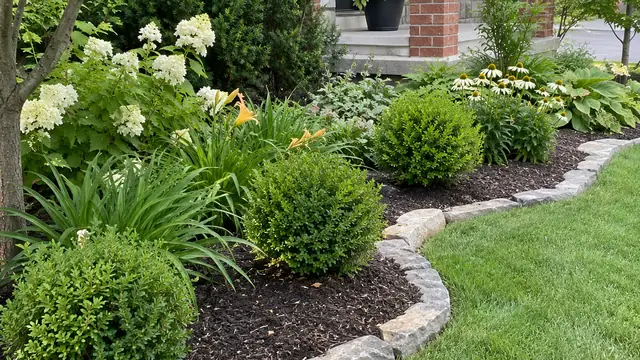
Good front yard landscaping comes down to a clear, comfortable path to the door, crisp bed edges, a handful of plants repeated rather than one of everything, and some evergreen structure so the yard still looks finished in winter. Keep it in scale with the house and easy to maintain.
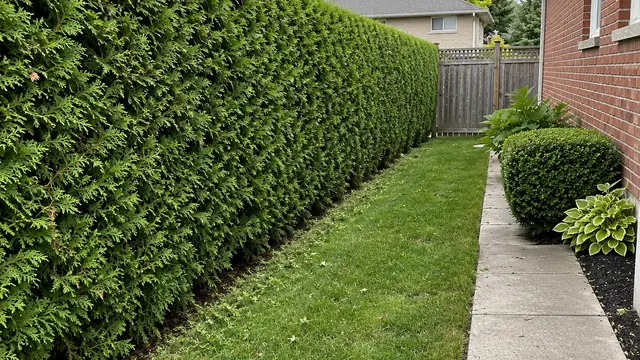
Most front yards in Milton subdivisions like Willmott or Ford are compact, so a typical refresh might be a new interlock walkway, a curved foundation bed planted in layers, fresh sod installation where the lawn has thinned, and overgrown cedars brought back into shape with hedge trimming. Beds against the foundation should still slope away from the house so they never send water toward the basement.
How much does landscape design and planting cost?
Landscape design and planting is priced by the job after a free quote. Cost depends on bed size, the number and size of plants (a 1-gallon perennial versus a 2-metre tree), how much soil and compost the clay needs, removal of old shrubs or sod, access and disposal.
We take on planting projects across Milton and Mississauga, plus Oakville, Burlington, Halton Hills, Brampton and west Toronto. Send your address and a few photos on WhatsApp at 437-433-1994 and we usually reply the same day. New customers get $25 off their first service, which goes a long way on a small front bed.