Salt damage on lawn edges, interlock and concrete is mostly avoidable. Which ice melt to use on pavers, how to use less of it, and how to repair a salt-burned lawn in spring.
How does rock salt damage your lawn?
Salt damage on lawn edges happens two ways. Salt in the soil holds water away from the roots, so grass suffers drought even in wet ground. Sodium also breaks down the structure of clay soil, sealing it up much like compaction. The result is the brown strip you see along driveways every April.
It shows up wherever salty snow lands: beside the driveway, along the sidewalk and in the corner where the plow piles everything. Grass closest to the pavement dies first, and the damage fades as you move into the lawn. Unlike grubs or snow mould, it follows the shape of where snow was thrown.
University of Nebraska-Lincoln turf specialists separate two problems. Salinity, too much salt overall, is fixed only by leaching it below the roots with water. Sodicity, sodium wrecking soil structure, happens in fine clay soils and is what gypsum is for. Sandy soils do not get the structure problem because they have little structure to lose.
Does rock salt damage concrete and interlock?
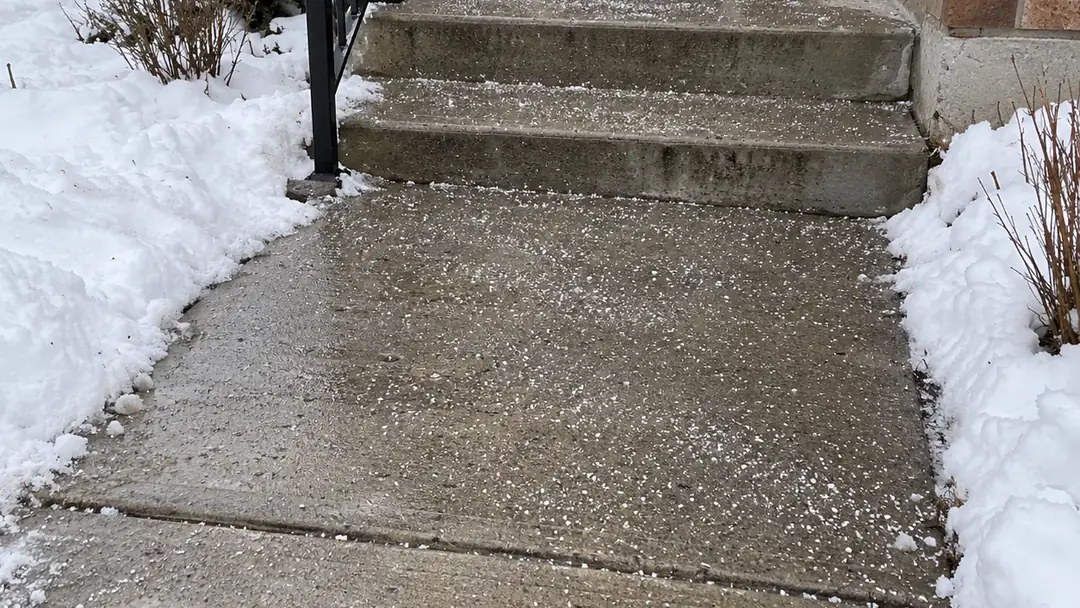
Yes, mostly through freeze-thaw. Water and salt soak into the fine pores of concrete, and when they freeze or crystallize, small flakes break off the surface. That is scaling, sometimes called spalling. New concrete, and concrete without proper air entrainment, is the most vulnerable, and interlock pavers are concrete too.
University of Nebraska Extension recommends air-entrained concrete with proper cement content, correct curing, and air drying new concrete for at least 30 days before its first freeze. Sealers help by keeping water and salt out. Avoid ammonium nitrate and ammonium sulfate, which UNL says damage concrete more than sodium or calcium chloride.
For pavers, the Concrete Masonry and Hardscapes Association says rock salt is the least damaging de-icer and should be used whenever possible. Calcium chloride can be used judiciously when you need faster action. Magnesium chloride and CMA are not recommended because they can chemically degrade concrete. CMHA also advises against over-applying, and wants loosened snow, ice and leftover salt removed promptly so it does not build up. If your polymeric joints are cracked or washed out, our interlock and hardscaping crew can re-sand them in spring.
Calcium chloride vs sodium chloride: which ice melt works best?
For most GTA driveways, plain rock salt (sodium chloride) is the best value down to about -9°C and the least damaging choice for concrete pavers. Calcium chloride works to about -29°C and acts faster because it gives off heat as it dissolves, so keep a bag for deep cold. Sand melts nothing but adds traction.
Temperatures below are the lowest practical working temperature from the Sustainable Technologies Evaluation Program (STEP), whose brief was funded by Ontario's environment ministry. Treated salt, rock salt coated with magnesium or calcium chloride, is a middle ground STEP rates to -17°C, which is why many municipalities use it.
| Product | Lowest practical temperature | Lawn and plants | Concrete and interlock |
|---|---|---|---|
| Sodium chloride (rock salt) | -9°C (STEP); Peel Region says about -10°C | Can burn plants; sodium damages clay soil | Least damaging for pavers (CMHA); can scale weak or new concrete |
| Calcium chloride | -29°C (STEP) | No sodium, but still a salt; keep it off beds | Use judiciously on pavers when speed matters (CMHA) |
| Magnesium chloride | -15°C (STEP) | No sodium, but still a salt | Not recommended on pavers (CMHA) |
| Potassium chloride | Less effective in cold, often blended (USU Extension) | Gentler than rock salt (USU), but its high salt index can still burn foliage (UNL) | Listed as corrosive to concrete (USU Extension) |
| Calcium magnesium acetate (CMA) | -7°C, best above -5°C (STEP) | Little impact on plants and animals (UNL) | Not recommended on pavers (CMHA) |
| Sand or grit | Traction only, does not melt (Peel Region) | Harmless to grass; rake it out in spring | No chemical damage; sweep it up |
Is there a pet safe ice melt in Ontario?
There is no product that is both perfectly gentle on pets and safe for interlock, so it is a trade-off. CMA has little impact on plants and animals, according to University of Nebraska Extension, but CMHA does not recommend it on pavers and it only works to about -7°C. Less product plus sand is the safest routine.
Potassium chloride is often sold as the gentler option, but UNL notes its high salt index can burn foliage and stop roots forming, so it is not a free pass for the lawn. Peel Region suggests sand, grit or non-clumping kitty litter for traction when it is too cold for salt to work. After walks, wipe your dog's paws and belly, and keep bags of any melter sealed and out of reach.
How can you use less salt and stay safe?
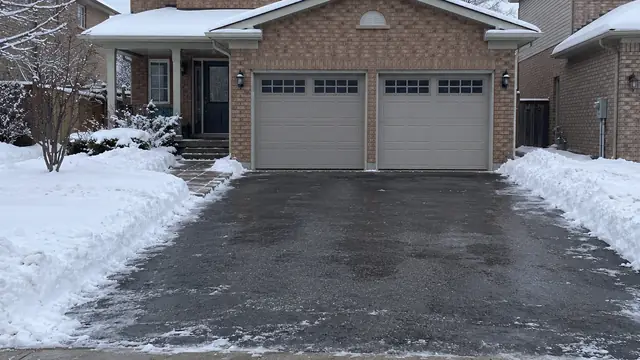
Clear first, salt second. Shovel or plow down to the pavement, then spread a thin, even layer only where people walk and drive. Put a little down before a freeze so ice cannot bond, switch to sand when it is colder than about -10°C, and sweep up leftover salt once the ice is gone.
If you hire out, Peel Region suggests looking for contractors that are Smart About Salt. Property managers can write salt rules into the contract using our commercial snow removal checklist. For your own driveway, this is the routine:
- Shovel or plow as soon as you can; packed snow turns to ice that needs far more salt.
- Spread a small amount before snow or a freeze so ice does not stick (Peel Region's tip).
- After a snowfall, salt only once the snow is removed, and only where it is needed for safety.
- Below about -10°C, switch to sand or grit for traction.
- Pile snow where meltwater will not run back across the walk and refreeze, and never onto the road (see local snow rules).
- Point downspouts away from driveways and walkways.
- Sweep up leftover salt and sand when the ice is gone, before it washes into the lawn.
How do you fix salt damage on lawn in spring?
Once the ground thaws, flush the damaged strip with deep watering to push salt below the roots. Add gypsum only if a soil test shows sodium in clay soil. Then rake out the dead grass, loosen the surface, topdress and overseed, and keep the seed moist until it is established.
- Flush: water the strip deeply after the last freeze. UNL calls leaching salt past the roots the only fix for salinity, and spring rain helps.
- Test before gypsum: gypsum displaces sodium in clay soils, but it is a salt itself and can make a plain salinity problem worse.
- Rake out dead grass and loosen the top layer, or core aerate the edge.
- Topdress with screened soil and overseed with a mix suited to Ontario lawns.
- Water lightly and often until the new grass is established, and mow it high at first.
Getting help with spring repair
Our aeration and overseeding service handles salt-burned edges, and the spring lawn care checklist for the GTA covers the rest of the April list. For seed, see the best grass seed for Ontario lawns and our overseeding guide.
Is salt included in Lawn By Moe snow contracts?
Yes. Our residential seasonal snow removal contracts include salt, along with plowing the driveway and shovelling walkways and front steps whenever snow reaches 5 cm. The season runs November 1 to April 30 with 6 monthly payments. Quotes are free, usually the same day, on WhatsApp at 437-433-1994.
Mention new concrete, fresh interlock or a lawn edge that browned last spring when you ask for a quote, so the crew knows about it before the first storm. Snow is piled on your property, so it is worth agreeing on a spot away from the beds you care about. See GTA residential snow removal, what snow removal costs in Milton and Mississauga and what a seasonal contract should include.
Frequently Asked Questions
Will grass grow back after salt damage?
Often, if the roots survived. Flush the strip with deep watering after the last freeze to move salt below the root zone, then rake and overseed whatever does not green up. Heavy, repeated damage in clay soil may also need gypsum, but only after a soil test confirms a sodium problem.
What is the best ice melt for interlock?
Plain rock salt, used sparingly. The Concrete Masonry and Hardscapes Association calls sodium chloride the least damaging de-icer for concrete pavers, allows calcium chloride judiciously for faster action, and advises against magnesium chloride and CMA. Shovel first, and sweep up the excess so it does not build up in the joints.
Calcium chloride or sodium chloride: which is better?
Calcium chloride works much colder, to about -29°C versus about -9°C for rock salt, and gives off heat as it dissolves, so it acts faster. Rock salt is cheaper and the gentler choice for concrete pavers. Use rock salt on typical winter days and keep calcium chloride for deep cold.
Does salt damage new concrete?
It can. New concrete is the most vulnerable to scaling, so University of Nebraska Extension advises letting it air dry for at least 30 days before its first freeze. If your driveway was poured this fall, ask your installer before using any de-icer, use sand for traction meanwhile, and tell your snow contractor.
Is road salt bad for the environment?
Peel Region notes that salt does not disappear when snow melts: it travels with meltwater into rivers and lakes and, over time, harms wildlife and drinking water quality. Clearing snow before salting, using less, and switching to sand in deep cold all cut the amount that leaves your property.
Sources
- Sustainable Technologies Evaluation Program: Alternatives to Salt, technical brief (2020)
- Region of Peel: Reducing and managing salt use
- Concrete Masonry and Hardscapes Association: The Effects of Deicing Chemicals on Interlocking Concrete Pavers (PAV-FAQ-001)
- University of Nebraska-Lincoln Extension: Winter Deicing Agents for the Homeowner (G1121)
- University of Nebraska-Lincoln Turf iNfo, via STMA: Understanding soil salinity and sodicity after winter
- Utah State University Extension: De-icing Compounds
Want Us to Handle It?
Lawn By Moe is based in Milton and serves Mississauga, Oakville, Burlington, Halton Hills, Brampton and the GTA. Free quotes, usually the same day.